
Revive your design superpowers
You are more powerful than you realize

The world needs designers! Now more than ever. I’ve made two books and a short film about how important designers are. That’s how much I believe this is true.
Every time the world turns, people doubt design. My faith is unshaken.
But designers are prone to feeling lost. It’s in our nature. We’re often outsiders. We often feel misunderstood and undervalued. And while convincing other people can be tiring, the answer might just be convincing yourself. You may have forgotten what makes you special in the working world.
Here is a summary of what Why Design Is Hard teaches about your design superpowers.
You are a great investigator
Designers are naturally curious. They always have questions, and then questions about the answers to those questions We don’t accept things at face value: we want to understand how things really work, and why they are the way they are. We want user research, market research, web analytics, and any source that might help us answer our questions. We know that data is a flashlight that helps us see the truth, and we want to design for the world as it really is.
If we can spend hours reading about the 16th-century French history behind the beloved font Garamond, or studying the details of the design prototypes Jonathan Ives made to create the first iPhone, we have the rare capacity to discover and digest layers of complex information for practical use in solving problems.
Our investigative curiosity is magical in two ways.
We can use it to find better answers to important questions organizational leaders have. The fastest way to influence is to ask leaders what they are worried about and solve their problems.
We can aim our investigative powers at things that we find annoying, like dismissive coworkers, dumb bureaucratic processes, frustrating clients, and short-sighted executives.
Ted Lasso said, “Be curious, not judgmental,” and to that I’d add, it’s only by being curious, rather than judgmental, that we make discoveries toward reframing our frustrations into solutions. Instead of obsessing about not having a seat at the table or why our ideas get ignored, reframe the problem to make it actionable.
You are a great explainer
The biblical Tower of Babel fell not because of failed design or engineering knowledge, but because the people building it lost the ability to understand each other. The same problem explains the dysfunctions of many organizations. The working world is an overwhelming sea of jargon and doublespeak, spoken and written words that drown productivity and morale. Even smart, talented, well-intentioned people end up confused, disorganized, and demoralized. Expensive productivity apps and communication tools are perennially promised as the solution, but it’s a fantasy silver bullet because the real problem is social—a lack of communication skills and common language—not technological.
This means someone who explains things clearly, including through insightful sketches, diagrams, or metaphors, has tremendous value. Explainers help people make sense of each other. Designers are often shy about their ability to explain things, but typically we’re better at this than other professionals, since our work is rooted in communication (even visual design is rooted in semiotics, the study of symbols and their meaning). If we can be curious about our coworkers’ perspectives, objectives, and frustrations, we can be translators.
Translators have power: they can become the key link in how project teams function. Good leaders depend on their translation skills to earn trust and help better ideas arise. Designers can also do this, and when we do, our jobs become easier.
You are a great negotiator of ideas
When you explore different ideas for how to solve a problem, what is the conversation like in your mind? We know that most designers compare different possibilities, exploring why one might be better (or seeking ways to combine the best of both). Another term for this is a tradeoff: finding the balance between two (or more) competing goals. For example, in visual design, the concept of composition is about making tradeoffs between whitespace, hierarchy, and contrast to find balance.
If you don’t do this, and everything gets equal attention, it’s probably a confusing, ugly failure. Similarly, a product that tries to do too many things, like a Swiss Army Knife, probably doesn’t do any of them particularly well. Making tradeoffs is central to what designers do.
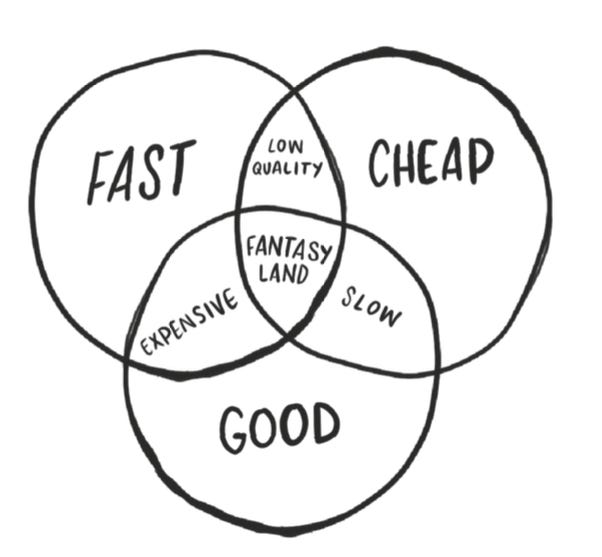
A great lesson about tradeoffs is found in an old adage, often seen on signs in dive bars and diners: “We offer three kinds of service: GOOD, CHEAP & FAST. You can pick any two.” It sounds like a joke, but this same idea in the business world has been called the iron triangle since the 1950s.14 It’s a real law of constraints that experienced project leaders know well because it captures how hard it is to make quality things. The triangle is a reminder to good leaders that they must make tradeoffs to succeed, and that’s often done by setting clear, realistic goals. On the other (much stupider) hand, bad leaders assume they are immune from the triangle (i.e., the Dunning Kruger effect), which leads to failed projects that are slow, expensive, and bad, the trifecta of failure (aka the failfecta).
For designers, the breakthrough is to use our tradeoff talents when working with other people. Being good at making tradeoffs with others is called negotiation. Good negotiators do more than just fight for their own position; they’re able to compare their own interests with the interests of the other side. They’re curious about the real reasons the other party has its position, rather than judging them for it. If we use our curiosity, we can uncover flawed assumptions in the other party’s thinking, or our own, leading to happier outcomes for everyone.
For more on how to make design easier, read Why Design Is Hard.